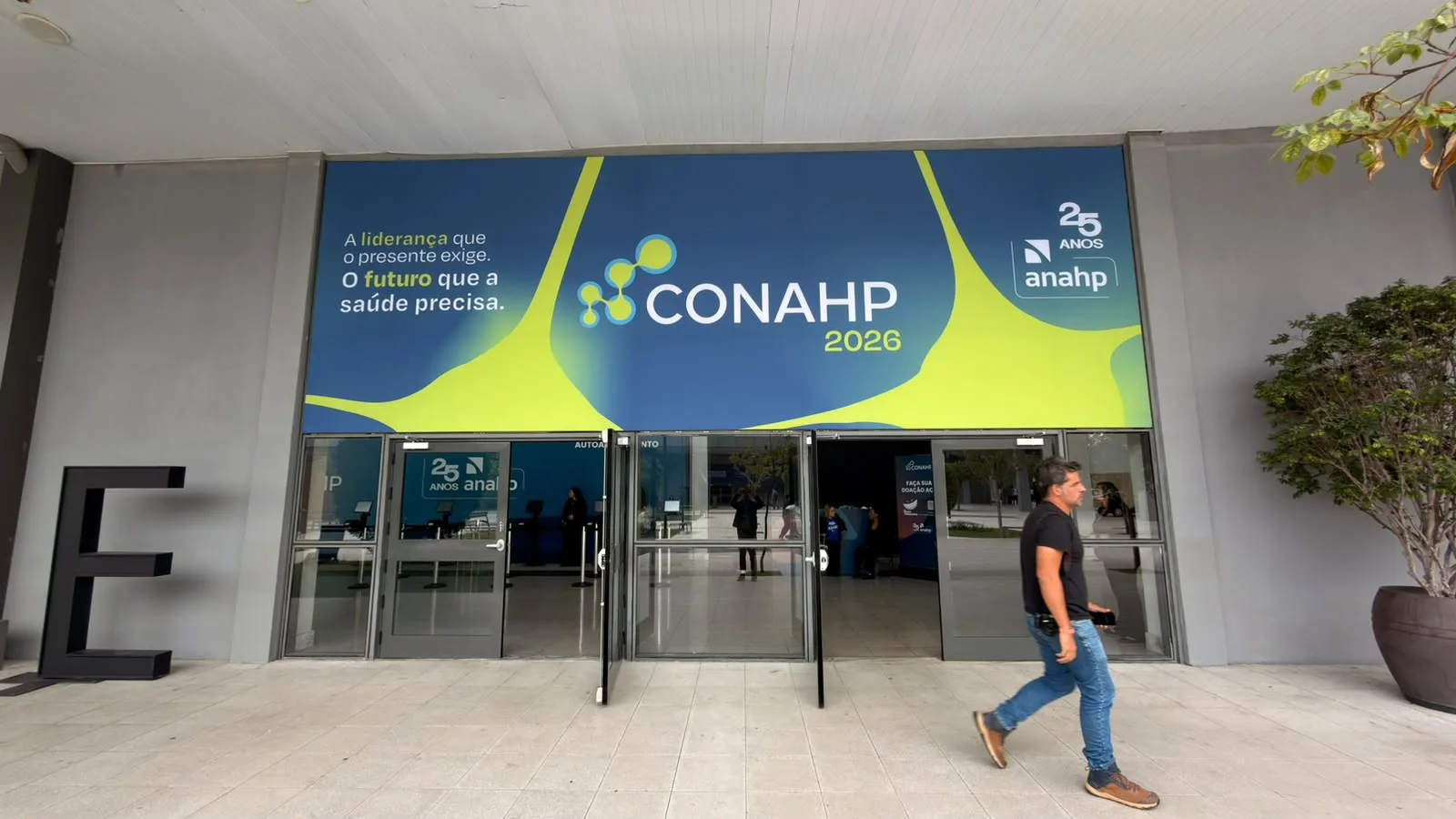
The National Congress of Private Hospitals (Conahp), organized by Anahp, arrives in 2026 celebrating the association's 25th anniversary. Two days, three simultaneous tracks and five themes (industry commitments; technology and intelligence; financing and sustainability; people, work and leadership; and social legitimacy and impact) bringing together the main leaders, managers and specialists in Brazilian healthcare.
For Accrua, Conahp is where the discussion about the future of hospitals meets the reality of operations. Much of this year's agenda (use of data, artificial intelligence, relationships with payers, payment models and financial sustainability) runs directly through the revenue cycle, where most of the losses hospitals don't see are concentrated today.
Who will be there
Accrua's partners will be present on both days of the conference, alongside clients who already run their revenue cycle with us. If you're going to Conahp and want to talk about denials, collection times, billing efficiency or working capital, book a time with our team.
The agenda we'll be following
From the official program, we selected the sessions on digital transformation, artificial intelligence applied to healthcare, revenue cycle and operational efficiency. The program is subject to change by the event organizers.
Digital transformation and artificial intelligence
From agentic AI to data interoperability: how technology moves beyond the pilot and starts generating value in operations.
-
Oct 1412:00 – 13:15Technology and Intelligence in Healthcare StageTalk + debate
The era of agentic AI in healthcare
April Saathoff (Johns Hopkins Health System) · Felipe Lora (Sabará Hospital Infantil) · Lilian Hoffmann (Hospital Care) · Diogo Porto Dias (Hospital Porto Dias) · Moderator: Alex Vieira (Hcor)
-
Oct 1415:30 – 16:45Technology and Intelligence in Healthcare StageDebate
Data and interoperability: the invisible infrastructure of healthcare transformation
Giovanni Cerri (InRad e InovaHC HC-FMUSP, ICOS) · Paula Xavier (DATASUS) · Adriana Ventura (Federal Deputy) · Moderator: Felipe Cabral (Hospital Moinhos de Vento)
-
Oct 1417:30 – 18:45Technology and Intelligence in Healthcare StageDebate
Artificial intelligence in healthcare: where it already creates value and what is still a promise
Marco Bego (InRad HC-FMUSP) · Edgar Gil (Grupo Fleury) · Rubens Barreto (Grupo Santa) · Moderator: Victor Gadelha (Dasa)
-
Oct 159:00 – 10:15Social Legitimacy and Impact StageTalk + debate
Disruption in healthcare: what worked, what failed and what needs to be redesigned
Ann Somers Hogg (Christensen Institute) · Claudio Lottenberg (Einstein) · Romeu Domingues (Dasa) · Moderator: Daniel Greca (Hospital Sírio-Libanês)
-
Oct 1513:30 – 14:45Industry Commitments StageCase · Talk + debate
Learning from other industries | Open Finance: when interoperability stops being talk and becomes reality
Eduarda Davidovic (Febraban) · Renato Casarotti (Grupo Amil) · Jacson Barros (AWS) · Vitor Ferreira (ABCIS) · Moderator: José Marcelo (Hospital Alemão Oswaldo Cruz)
Revenue cycle, financing and payer relationships
Incentives, trust between hospitals and payers, and new payment models: the topics that determine how much revenue reaches the bank.
-
Oct 1412:00 – 13:15Financing and Sustainability StageTalk + debate
The challenge of aligning incentives, outcomes and the sustainability of health systems
Emmanuel Lacerda (SESI) · Mauro Junqueira (Conasems) · Denizar Vianna (IESS) · Frederico Magro (Sanofi Specialty Care) · Moderator: Ary Ribeiro (Elibré)
-
Oct 1415:30 – 16:45Financing and Sustainability StageDebate
The price of distrust and the convergence agenda in private healthcare
Bruno Sobral (FenaSaúde) · José Henrique Salvador (Rede Mater Dei) · Mário Jorge Vital (Unidas) · Lara Vieira (Pompéia Ecossistema de Saúde) · Moderator: Evandro Moraes (Hospital São Lucas da PUCRS)
-
Oct 1417:30 – 18:45Financing and Sustainability StageCase + debate
Value-based payment: why the model still doesn't scale and what needs to change?
Daniela Medeiros (Unimed Porto Alegre) · Nidia Paulina (Colsanitas) · César Abicalaffe (IBRAVS) · Vanessa Teich (Einstein) · Renata Sartório (Danone) · Moderator: Marcia Makdisse (Academia VBHC)
-
Oct 1511:00 – 12:15Industry Commitments StageDebate
The future of private healthcare: paths for the model's evolution
Renata Salvador (VP of Sales and Revenue Cycle, Rede Mater Dei) · Eduardo Spinussi (Fundação Zerrenner) · Dominic Lourenço (DIPRO/ANS) · Moderator: Victor Piana (A.C.Camargo Cancer Center)
Operational efficiency and sustainability of the hospital model
The debate on hospital viability over the next 25 years and the paths to scale with efficiency.
-
Oct 149:00 – 10:15PlenaryPanel
Board Members Panel: will the current hospital model still be sustainable over the next 25 years?
Eduardo Amaro · Henrique Neves · Fernando Ganem · Gustavo Fiuza · Henrique Salvador · Júlio Vieira · Rogério Reis · Mohamed Parrini · Fernando Torelly · Moderator: Antônio Britto (Anahp)
-
Oct 1415:30 – 16:45Industry Commitments StageDebate
Healthcare in Brazil: can public-private integration be a path to expand access and efficiency?
Antônio José Pereira (Hospital Sírio-Libanês) · Thaís Junqueira (Umane) · Mohamed Parrini (Hospital Moinhos de Vento) · Denilson de Santa Clara (Rede Santa Catarina) · Moderator: Marco Aurélio (Anahp)
-
Oct 1515:30 – 16:45Industry Commitments StageDebate
Care coordination: how to scale integrated models in Brazil?
Massanori Shibata Jr (Dr. Consulta) · Eugênio Vilaça (Conass) · Rafael Ielpo (A.C.Camargo Cancer Center) · Matheus Moraes (Alice) · Moderator: Cesar Franco
Why these topics matter for the revenue cycle
AI only creates value when it enters operations. Authorization, claims auditing and bill assembly are repetitive, rule-driven processes, and that is where AI agents with human validation already show measurable results. Wednesday's session question, about where AI already creates value and where it is still a promise, is the same one we ask at every stage of the cycle.
Interoperability is revenue infrastructure. When the medical record, billing and the payer don't talk to each other, every bill is rebuilt manually, and every rebuild is an opportunity for error, denial or delay. The parallel with Open Finance shows that standardizing data exchange changes the economics of an entire industry.
Distrust has a cost, and it shows up in denials. The convergence agenda between hospitals and payers, as well as the evolution of value-based payment, requires the hospital to know precisely its own costs, the rules of each contract and the behavior of each receivable. Without that, no payment model holds up.